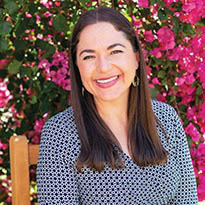
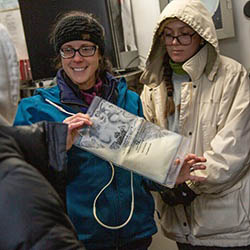
And challenge she did. Despite her grueling athletic demands, Rascón completed a nursing degree within her three remaining years. She also studied abroad in Jamaica and Mexico, fueled by a visit to her father’s Colombian homeland at age 10. These experiences inspired her to co-found Hartwick’s Nursing Students Without Borders chapter with Colleen Henry ’07 during her senior year.
Ever since, it’s been more of the same. She has served as an acute care nurse in oncology, medical-surgical and trauma/ICU settings. She’s worked in undeveloped regions in Peru and the Solomon Islands, including a jungle. She’s added a master’s in nursing education and a Ph.D. in nursing focused on Type 2 diabetes research. She’s taught 18 different Arizona State undergraduate and graduate courses, including launching the Edson College of Nursing and Health Innovation’s first study abroad program.
“I’m not afraid of failing when I see a chance to experience things that require steep learning curves,” she shared. “I really enjoy building that ‘muscle,’ even though I might not be great at it the first time.”
Most recently, Rascón forced herself outside of her comfort zone yet again, transitioning from a predominantly teaching role to an emphasis in research. She’s pursuing implementation science, which goes beyond the comforts of a lab setting, placing researchers into communities to study how to best implement science-based interventions like education programs. She plans to pilot a statewide referral network designed to reduce healthcare barriers associated with Type II diabetes prevention.
“There’s a lot of research out there that tells us what ‘works,’ but it’s not always being implemented the way it is needed and disseminated the way it should,” Rascón explained. “And it instantly gets messy. You’re looking at real life — not a controlled environment. It’s not bench science. I’m not using microscopes. I’m talking to people.”
Specifically, she’s part of a research team testing the effects of a family-based diabetes prevention program, as she attempts to understand how family dynamics impact nutrition, exercise and other health behaviors. When paired with issues like food and housing insecurity, a patient’s ability to participate in diabetes prevention programs and follow prescribed instructions are diminished.
“It’s so rewarding because you get to help a lot of people in the broadest sense,” she added, “but it’s also a huge challenge, because there’s so much to learn. It can be humbling.”
Rascón thinks back often to her Hartwick days and the many people who helped her launch this career that she’s fully embraced.
“I have such gratitude for the mentorship I received,” she said. “I remember feeling so very taken care of by my faculty. I was a complicated student-athlete, traveling to tournaments …studying abroad. If they hadn’t done all of that, I’m not sure I’d have taken those leaps. It meant the world to me. I thought, if they believed in me, I must know something. I must have some potential.”
Potential, those mentors might say, that appears boundless.