Building Better Paths for Others
Legislative coordinator helps people overcome barriers she faced
When Tatyana McGuire ’25 was seven years old, her mother woke her and two younger siblings up one night. She told them they had to leave their Harlem, N.Y., home right away.
The children did so — quietly, as their mother instructed, and fled into the night. They went to the home of a friend for a few days. Then another. They soon moved to a homeless shelter. Then another. They didn’t question any of it because they were so young, but in time, her mother shared that they left because her father was abusing her.
The problem was, he wasn’t.
Her mother was suffering from the beginning stages of Alzheimer’s disease, despite only being in her early 40s.
“What she thought was real were actually memories of her first marriage, to a man who really did put his hands on her,” McGuire said. “My father would have never done that.”
McGuire would later learn that her father began noticing issues with her mother. She started confusing things like oil with apple juice. She began misplacing things and repeating herself. Her father encouraged her to go to the doctor, but the working-class family had limited insurance coverage and her mother did not receive the specialized attention she needed.
Her father, a department store salesman, also had limited means to find them in the pre-smart phone era. He tried for several months with no luck. She and her siblings moved from Brooklyn to Queens, and eventually to a domestic violence shelter in The Bronx, whose staff noticed the same issues her father had.
Fortunately, the shelter was across the street from Public School 140. Its principal took to Tatyana, mentoring her and personally covering some supplies. It was exactly what she needed.
“That really helped me find stability and gain some traction,” she explained. “I never liked school before, but I realized I did like math. There’s only one answer; it wasn’t subjective like English and other subjects.”
That success helped her do better in all subjects, as did the after-school program, which helped her stay on top of homework and make friends. In time, she realized that school could become her way out of poverty, so she took it seriously.
Then she had another stroke of luck: a chance run-in with Maria, her 18-year-old half-sister from her mother’s previous marriage. Maria was also familiar with her mother’s struggles.
“She wrote down her phone number on a brown paper bag,” McGuire recalls. “She said, ‘If you ever need me, call.’”
It didn’t take long. Her mother began to occasionally disappear from the shelter but would return later at night.
Then one night, she didn’t.
Maria rushed to the shelter to do what she could to care for Tatyana and her siblings. She essentially became their guardian after her mother received a proper diagnosis: she suffered from Alzheimer’s disease, dementia and bipolar disorder. Maria put her own college plans on hold and helped make sure her siblings had the support they needed to get through school.
Still, as the years went by, it didn’t feel like it would be enough. It led Tatyana to decide she would join the military after high school, seeing it as the only affordable path to a college degree. She did well on some preliminary Air Force exams — but before she signed, a teacher encouraged her to attend just one college fair.
That decision changed her life.
“There was a recruiter from SUNY Adirondack who was kind and high-energy,” she said. “He highlighted all these opportunities…hiking, canoeing, arts, culinary…things I’d never experienced. I’d never even been outside of New York City!”
He said they offered a bus that traveled between campus and New York City, and his team helped her obtain financial aid, which was challenging because of her sister’s unofficial guardian status.
“It all taught me that I had to advocate for myself,” McGuire added. “I used to be very shy, only speaking when spoken to. But Maria taught me, ‘a closed mouth never gets fed.’”
McGuire found a great support system at Adirondack, where she played basketball, joined student government and became a residence assistant. She then met a Hartwick recruiter at a transfer fair and immediately recognized the similarities between the two mountain-region campuses.
“I liked that it was also a smaller school,” she said. “It felt like a place where I could become noticed.”
Noticed, she was — especially by her political science and criminal justice faculty. They encouraged her to get involved on campus and register to vote so her voice could be heard.
“Growing up, I thought my voice didn’t matter, but Hartwick taught me that wasn’t the case at all,” she said. “They were amazing professors who showed me how many things affect people like me.”
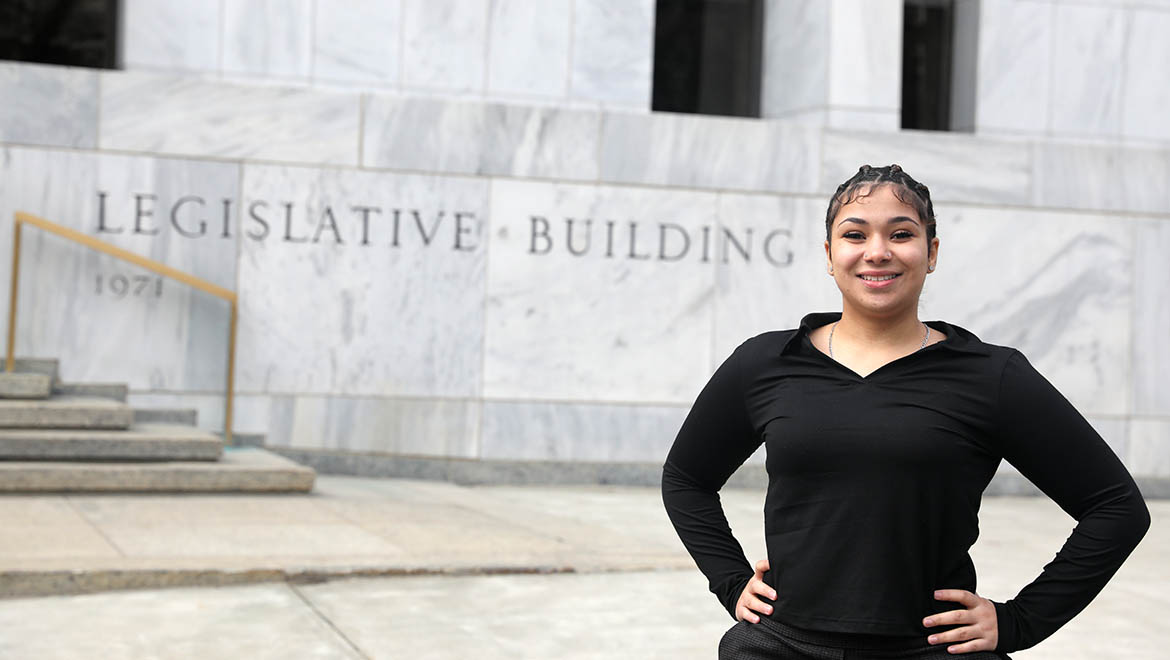
They also helped her earn an internship in the spring of 2024 — one she could never have dreamed of while growing up. She worked for Assemblyman Manny De Los Santos, the 72nd district representative from her New York City home. McGuire impressed again, and shortly after graduating, she was hired as his legislative coordinator.
Today, McGuire finds herself assisting and fighting for families who remind her a lot of her own. Her team is working to keep things affordable, including maintaining SNAP benefits, healthcare and affordable housing options impacted by last year’s federal cuts. She is particularly inspired by the collaboration she sees across the political aisle — a notable difference between state and federal politics currently, she adds.
“I’m seeing assemblymembers who are working so hard — not for their own political gain, but because they really care,” she said. “I see the focus they have and the little things they do to carry through on a promise.”
At age 24, she is the youngest staffer on De Los Santos’ team. That has its advantages, she says, especially when working with younger people on initiatives like mental health advocacy. She’s also happy to work for an official who values her perspective.
“He shows us off!” McGuire says of De Los Santos’ approach to his younger staffers. “We’re not stuck in an office. We’re out in public, at meetings, press conferences…it inspires others when they see the people on his team.”
Now that she’s a professional, McGuire can reflect on her journey. She’s so appreciative of everyone in her life — including her mother, who passed away in 2020.
“She did her best, despite her struggles,” she says.
McGuire has also inspired her siblings. Her younger sister is going to a community college with hopes of becoming a social worker; her brother graduated from high school last year and has entered the skilled trades; and Maria, as her responsibilities lessened, was able to earn an associate’s degree in nursing and is now working toward her bachelor’s degree.
“It’s really great to see,” McGuire says, “and I’ve been able to guide them through the processes because I’ve been through it all.”
Best of all, McGuire gets up every morning knowing she has a chance to make a difference in someone’s life — and that’s truly motivating.
“With everything I’ve been through, I don’t ever want to go through it again or put my children through it,” she reflected. “No one should have to. It used to feel like I was just surviving. Now, there’s so much that I can do. I’m not limited anymore.”