Freedman Prize Research Examines Student-Athlete Mental Health
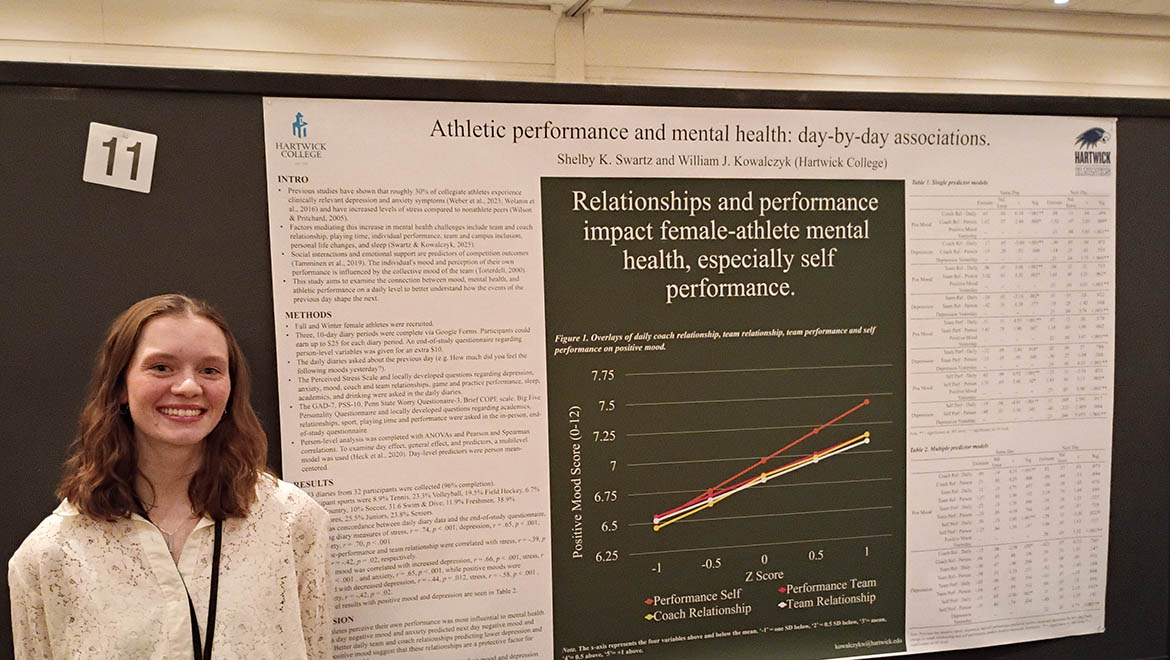
Shelby Swartz ’26, a biology and psychology double major, examined the day-to-day factors that influence the mental health of collegiate athletes through research supported by the Freedman Prize for Student-Faculty Research.
To collect data, Swartz conducted a daily diary study of female student-athletes at Hartwick, tracking mental health, relationships with coaches and teammates, self and team performance, sleep and academics. Each diary spanned 10 consecutive days and was repeated three times during the athletic season. The project grew out of research she conducted last year with Professor Bill Kowalczyk, focused on how mental health evolves over a season, with the goal of understanding how those factors shift from day to day.
“We wanted to take a closer look at how these factors change on a daily level and how events from the previous day can shape the next,” Swartz said. “Looking at those day-to-day patterns helped us better understand what influences athletes’ mental health.”
The findings underscore the importance of relationships and performance in shaping athletes’ well-being.
“We found that relationships and performance impact female athletes’ mental health, especially self-performance,” Swartz said. “How athletes perceived their performance often shaped how they viewed their mood and depression for the entire day.”
Support for the project came from the Freedman Prize for Student-Faculty Research, a competitive award established by Allen and Judy Freedman in 2002 to fund original collaborative work between students and faculty. Swartz was named a 2025 recipient and awarded approximately $4,000.
William Kowalczyk, associate professor of psychology and department chair and the faculty collaborator on this research, said projects like Swartz’s highlight the value of student research.
“I quite frankly just love it,” Kowalczyk said. “Having a project like this, one that is so close to the concerns of our large body of student-athletes, helps to motivate others to realize the utility of research and science literacy. That research is one of the best ways to truly know about something we are interested in and love.”
Swartz presented the project at the 2026 Eastern Psychological Association Conference in Boston and will also present the research at the Northeast Regional Honors Conference in New Haven, N.H., March 26–29. Reflecting on the project, Swartz said the experience deepened an interest in research and better prepared her for a future career in physical therapy.