Embracing Today's 'Wide World of Sports'

Hartwick’s strong athletics history provides new ways to compete outside – and inside – the classroom.

Hartwick College’s athletics history is one of its greatest sources of strength and pride. From conference championships and national qualifiers to women’s equality initiatives and a D-I men’s soccer national title in 1977, the Hawks have always maintained a commitment to excellence and innovation, whether on fields, pitches, diamonds, courts or in pools.

Although collegiate athletics looks vastly different than it did a few decades ago, that spirit is as present today on Oyaron Hill as ever.

Much of that is attributable to campus leaders’ focus on the ever-changing athletics landscape and asking, “How can Hartwick capitalize on these new opportunities?”

They have not been short on answers. They’ve re-established women’s softball as a varsity sport and added men’s volleyball and women’s flag football, all of which appeal to a new generation of prospective students. They’ve deepened their collaborations with Hartwick’s faculty and academic affairs leadership, complete with new majors in sport management and physical education. They’ve embraced advances in training, nutrition and mental health. They’ve even broadened the definition of “sport,” as evidenced by its 80-member Esports Club and state-of-the-art WICKed Esports Center, which opened last spring.

All of it has helped to boost enrollment and strengthen the education students receive within and beyond the classroom. That’s a strength which sets Hartwick apart, says Executive Director of Athletics Paul Vecchio.

“What strikes me is how the faculty and administration recognize the importance of athletics to our campus,” Vecchio said. “I’ve been delighted with the level of partnership we have, from recruiting and academic support to community building and alumni relations.”

The sport management major is an excellent example. As faculty researched and considered the opportunity with various liaisons, they also worked with Hartwick graduates who had found success in the field to refine the curriculum and bring the
program to life.

Chief among them was Thom Meredith ’73, who has enjoyed a 40-year career in the industry — through “pure serendipity,” he insists. From his beginnings at the Oneonta Daily Star sports desk, his journey has included public relations roles with the National Football League’s Tampa Bay Buccaneers and several North American Soccer League teams, én route to managing some of the world’s most prestigious athletic events, including the Pan American Games, Olympic Games and multiple FIFA World Cups. As one of North America’s foremost soccer event professionals, he has also boosted soccer’s growth in the U.S., and women’s professional soccer, in particular.

Meredith knew the depth and pedigree of Hartwick’s athletics history, including dozens of fellow Hawks who had gone on to become significant players in the field.

Thom Meredith ’73 during sport management lecture

“I saw these sport management programs starting up on various campuses across the country, and I felt that Hartwick was really ripe for that.”

Thom Meredith '73

Sport Management Industry Veteran

He began talking it over with some Hawk Legends from his era, including former Head Men’s Soccer Coach Al Miller, who led the team to three NCAA quarterfinal appearances and the programs first Final Four appearance in 1970; longtime collegiate and pro soccer coach Terry Fisher ’71; and Francisco Marcos ’68, a member of the National Soccer Hall of Fame and founder of the United Soccer League.

They met with Hartwick leaders at the National Association of Soccer Coaches Convention in Philadelphia to underscore their commitment to the new program, which launched officially in Fall 2024.

And launch it did — drawing broad support from other alumni and immediate interest among current and prospective students.

“We’ve been very pleased with the initial student response,” says Scott Dalrymple, Hartwick’s executive-in-residence and the inaugural sport management program coordinator. “We already have 53 majors and 39 minors in just year two (as of the fall census date). We were confident the program would be successful, but this has exceeded our expectations.” Meredith said.

STAYING IN THE GAME

That’s been the experience for Jen (Murphy) Picardo ’10, an accounting manager with Major League Baseball (MLB)’s Washington Nationals. As an undergraduate, the former field hockey captain knew she wanted a career in sports administration. Since no clear-cut major fit her at the time, Picardo worked with her advisor to create her own curriculum. She added athletic fundraising to her résumé as one of the first student workers for the Wick Athletic Association (the precursor to today’s Talon Trust). She also worked in the Athletics Department, secured multiple sports-related summer internships, and served as the Student Athlete Advisory Committee’s event coordinator.

“(Field Hockey Coach) Anna Meyer changed my life,” said Picardo, a three-sport high school athlete who initially leaned toward playing ice hockey in college. “I remember, she met me as I was parking my car for my tour, and she even introduced me to the president. The community felt so genuine. I thought I’d be drawn to a big-city school, but I remember standing at the top of Oyaron Hill, knowing this was the place for me.”

Picardo has been with the Nationals for 13 years in several capacities. She’s had the joy of celebrating their 2019 World Series Championship and hosting MLB’s 2018 All-Star Game and the National Hockey League’s 2018 Winter Classic. She’s thrilled that Hartwick has added its sport management program and has already returned to campus to share her experiences with students.

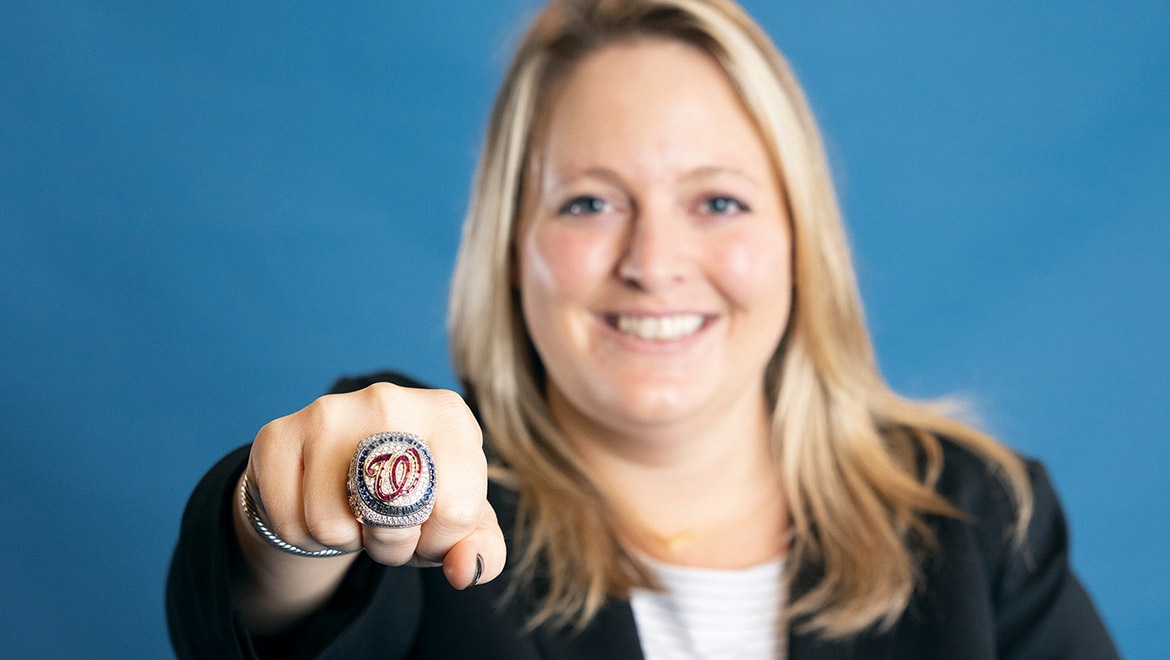
Jen Murphy Picardo ’10, an accounting manager with Major League Baseball (MLB)’s Washington Nationals with World Series Ring

The new major was a big draw for Samaj Barnwell ’27, a men’s basketball team member from the Atlanta suburb of Stockbridge, Ga. The recent transfer from California’s Santa Ana College quickly chose sport management, seeing it as more specialized than the marketing communications degree his junior college offered.

“I find the business management and financial sides of sports interesting,” says the starting forward whose dream is to one day be an NBA general manager. “You’re the key person between the owners and players. You’re managing coaches, athletes — basically everything off the court. You’re also given the final word on a lot of decisions… trades, free agent signings, scouting, drafts, travel and cuts. You’re building a lot of relationships.”

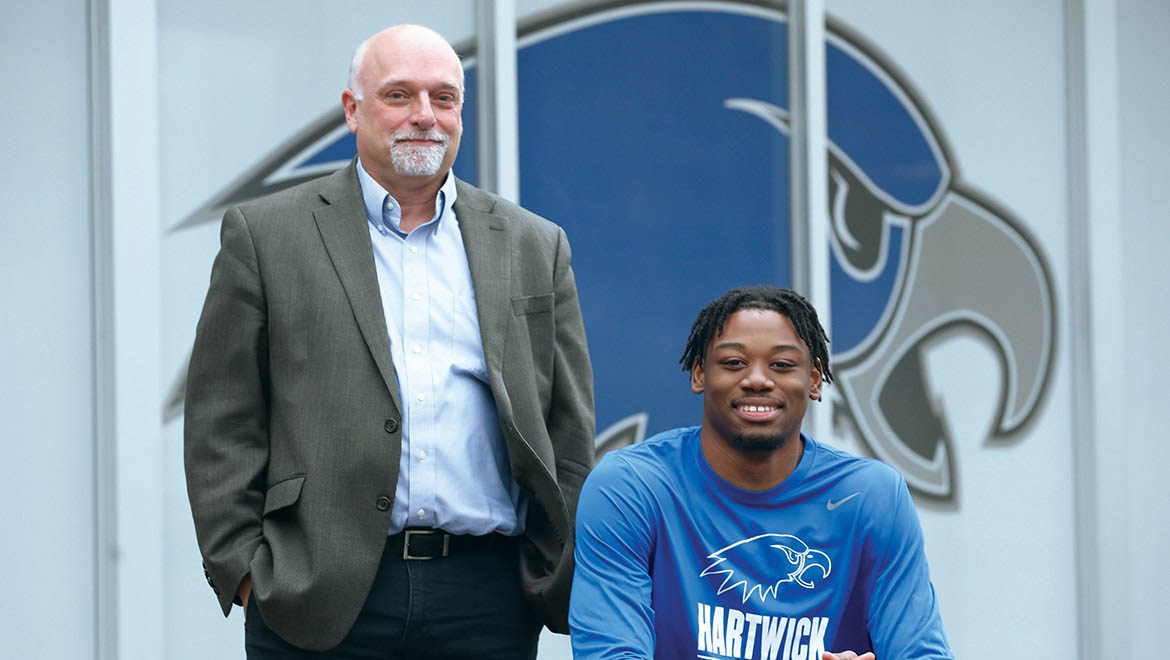
Samaj Barnwell ’27 with Scott Dalrymple, Hartwick’s executive-in-residence and the inaugural sport management program coordinator

LEARNING FROM THE PAST

Dalrymple credits Meredith’s many industry connections for helping the program generate such quick traction. He has already recruited several adjunct instructors and guest speakers, including Picardo, leading the college to create the Meredith Sport Management Speaker Series, to honor his extraordinary efforts.

Dalrymple is also grateful to the Athletics Department, which embraced the opportunity to contribute to students’ academic roles. It’s been a no-brainer for Vecchio, who believes Hartwick’s secret sauce lies in the blending of its historic and modern eras.

“We have an incredible athletic history — one most places would envy,” Vecchio said. “We’ve had 10 Final Four appearances across multiple sports, a team national championship at D-I, a two-time individual national champion at D-III, and nearly 200 All-Americans. We need to lean into that and celebrate it. When that happens, the excitement between our alumni and students is palpable. It all adds up to a very strong Hartwick education that we can all feel really good about.”

His opinion is shared by Associate Director of Athletics Betty Powell ’82, PM ’25, as she prepares to conclude a remarkable 56-year career at Hartwick.

She has seen students discover and appreciate those who came before them, and she understands the value of celebrating alumni and ensuring their legacies are not lost.

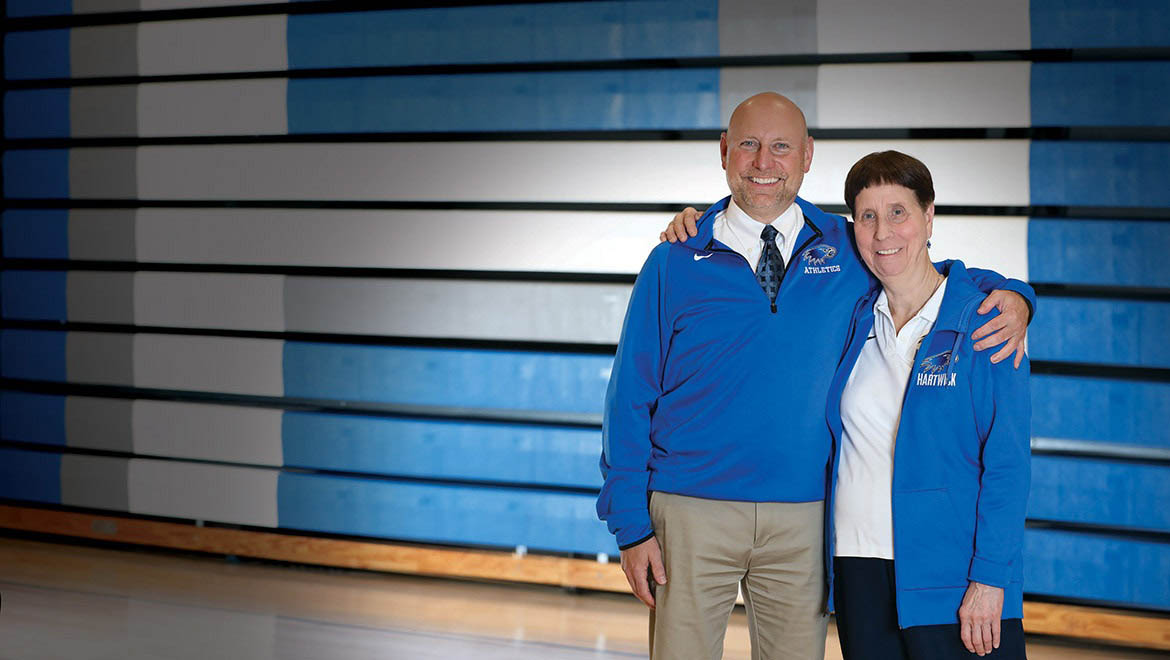
Betty Powell ’82, PM ’25 with Executive Director of Athletics Paul Vecchio

“We want to bring that history to the forefront, so today’s students understand where they are and the batons they have been passed to carry forward,” Powell attested. “It’s hard to know where you’re going if you don’t know where you were.”

Powell has witnessed a great deal, having held the roles of senior woman administrator (SWA) and compliance director as well. She was here at the start of Title IX and remembers the impact it had on the department and broader community. During her tenure, Powell has borne witness to the growth of women’s sports at Hartwick, including several milestones such as the 90th anniversary of the establishment of women’s basketball, and the 60th anniversaries of field hockey and women’s lacrosse. Several other women’s sports have been established during her time, particularly Hartwick’s former D-I water polo program, whose addition surprised many locals when it began.

“Many thought we’d just elevate women’s soccer to D-I, but they were already an established D-III program, so it would have been hard for us to recruit to that level at that point,” she explained.

Water polo, however, was unique on several levels. It wasn’t well known on the East Coast or driven at the high school level, nationally. Thus, it boosted Hartwick’s international student body, which added to the richness of cultures and diversity on campus. Powell recalls with great fondness the high-quality teams they assembled, often creating a David-vs.-Goliath setting that would bring Moyer Pool to a fever pitch.

“We played schools like Indiana and Michigan — and they would come to Hartwick, and we’d beat those schools,” she reflected. “It was an amazing time and a wonderful program.”

NEW CHOICES. NEW PREFERENCES.

Unfortunately, the broader collegiate sports landscape forced the end of the water polo program after the 2017-18 season. While it remains cherished by many — and still produces Hall of Famers, such as 2025 inductee and New Zealander Olivia Colebourne ’07 — its transition allowed other sports which are more regionally accessible to students to come to the foreground. Those include men’s volleyball, a sport rising in popularity thanks to some recent regional Olympians; and softball, now in year two, which has surged nationally due to a rise in television coverage.

“Softball has really resonated under the guidance of Head Coach Brittany Stroop,” Vecchio said. “She had a very healthy roster in year one and now has over 20 student athletes. We fielded a very competitive team in year one, which is difficult to do.” Then there’s flag football, whose recent backing by the NFL has fueled tremendous buzz, coast to coast.

“We’ve jumped on a fast-moving train with flag football, achieving our first-year recruitment goals fairly easily,” Vecchio noted. “Flag football started in the mid-Atlantic and New York is leading the way in that sport, especially in the northern states. It’s positioned us very well, regionally, and gives us access to more opportunities, nationally.”

To keep pace, Vecchio knows investments must be made as well. That includes upgrades to Wright Stadium and the athletic training room.

“The plan is to triple the size of our training space,” he reported. “We’re approaching 500 student athletes. The existing building was created in 1968, before we’d even brought football back. Those changes will make a big difference in our recruiting and retention efforts.”

BUILDING SOMETHING SPECIAL

For Dalrymple, the chance to lead such a pivotal program is invigorating. If its current momentum is any indicator, it’s easy to see why.

“By year four, we believe we can double our current numbers,” he projected. “If those numbers are realized, it would become one of Hartwick’s largest programs.”

His confidence is infectious, as he rattles off all the advantages. They include being surrounded by several athletic destinations — not to mention a major league pantheon.

“Oneonta really is a sports town,” he noted. “We have two colleges, two Little League ballpark complexes, a minor league team and the National Baseball Hall of Fame just down the road. It’s also the former home of the (National) Soccer Hall of Fame and still benefits from that history. We’re pretty wired into those communities and getting better every day.”

Perhaps the best example of this is Hartwick’s relationship with All-Star Village, the world-class baseball and softball resort just three miles from campus where the Hartwick softball program now plays.

“It’s pretty nice to say to prospective students that you’ll be playing in one of the best facilities on the East Coast,” added Vecchio. “They get to play on a turf field — a real advantage in Upstate New York winters. Being able to take a recruit to that facility is exciting.”

Of course, the National Baseball Hall of Fame is filled with opportunities on-site and on campus. That includes the presentation its president, Josh Rawitch, gave as this fall’s Meredith Sport Management Speaker Series’ keynote speaker. The former Arizona Diamondbacks and Los Angeles Dodgers executive is now in his fifth year leading the 86-year-old institution. He guides nearly 100 full-time staff who collectively work to preserve history, honor excellence and connect generations.

Rawitch’s appearance made quite an impression on Barnwell, knowing that an internship is required in order to graduate. He was surprised to learn of the variety of opportunities just minutes away in Cooperstown.

“I’ve been here less than four months now, and I’ve been impressed by the number of alumni and people in the field whom I’ve met,” acknowledged Barnwell, as he braced for his first Upstate New York snowfall. “The people here are so willing to introduce you to others who might help.”

While Meredith is pleased with the program’s early success, he isn’t surprised. The challenge, he says, is building up a deep portfolio of internships and other real-world opportunities for students — as well as conveying to them the realities of the business.

“We’re helping students understand it’s not all about the major leagues,” he said. “There are more attainable paths in amateur sports and niche spaces like wrestling, volleyball and event management, and they’re quite rewarding.

Dalrymple echoes those thoughts, stressing the importance of league governing bodies, regional conferences and the Olympic movement among the broad spectrum of careers.

“We want them to stop thinking it’s only about the Boston Celtics,” he said. “Our curriculum emphasizes career paths beyond the obvious. We’re looking at sports analytics. Fantasy sports is a very big business. Event management is huge, between tournaments, marathons and junior events. And the skills which they’re building are transferable across all of these areas.”

Picardo professes that guidance as well. Her big-league path began with the Trenton (NJ) Thunder, a double-A baseball team. She also worked in promotions, merchandising and business development roles that took her a bit outside of her comfort zone. Undeterred, she called upon her field hockey captaincy training to help her public-facing skills shine through.

“Even today, there’s not a day that goes by that I don’t use the skills I learned at Hartwick,” she attested. “The ability to schedule, multitask, lead, show accountability. These are all things I learned and improved upon on campus.”

Despite his own big-league dreams, Barnwell is listening to that advice and doesn’t expect an easy path to the pinnacle of his career.

“Whatever path leads to consistent growth is the one I’m interested in,” he says. “There’s a saying, ‘There are a million ways to get up a mountain, but there’s only one view.’ I’m not interested in following anyone else’s path. I just want to go at my own speed and find something that works for me.”

NEXT CHAPTERS

For Powell, as she reflects on her more than half-century tenure, you can hear a quiet satisfaction in her voice. She looks back on that secretarial position she accepted in August of 1969 — despite having never been an athlete — unaware of the marvelous experiences it would offer.

“Don’t ever shy away from an opportunity, because it can take you places you’d never imagine,” she advised. “I told myself, ‘Don’t be afraid to go for it. Get in there and show them!’”

She appreciates the advances she’s seen, especially among women in sports. She cites speed and skill improvements at all levels, as well as the SWA role, which gives female athletes a seat at the table and a window into all facets of a program. Still, she knows there’s more progress to be made.

“We forget, it’s only been a little over 50 years since Title IX was enacted,” Powell says. “We’ve seen growth, but it hasn’t grown as quickly as it should have. I think there aren’t as many women involved as there should be collegiately and professionally. There needs to be more growth for women at all levels of athletics, from opportunities as an athlete or coach, or at the athletic administration or managerial levels. We’ve made great progress in that here, and I was honored when I was asked to take on our SWA position.”

Powell is confidently passing the reins to Samantha Butcher, who will become assistant director of athletics, while Head Field Hockey Coach Erin Autera will assume the SWA role. Butcher, a three-time Empire 8 Coach of the Year, has built a powerhouse women’s tennis program, leading the Hawks to three conference championships in the last four years. Autera has also guided her squad to three Empire 8 championships, while recording the second-highest winning percentage in program history.

Like Powell, Picardo has seen steady gender-based progress in her world, including this year, when MLB welcomed its first female umpire, a moment which garnered national headlines.

“It’s great to see more and more females getting roles that you would have thought would always be held by a male,” she agreed. “We had a lot of women in high-ranking roles when I joined the team, including our chief marketing officer, but now we’re seeing it among our scouting and player development departments, too.”

Such paradigm shifts are necessary for survival, whether it be individuals, organizations or entire industries. That’s why Powell is so confident that the Athletics Department will continue to thrive long after she retires.

“Resilience — that’s the word that describes Hartwick Athletics and this college as a whole,” she summarized. “They have a way of reinventing themselves, looking forward and finding a way to move as life moves. The NCAA is going through a period of transition, especially at the D-I level, but the D-III philosophy helps preserve the true collegiate athletic experience. I enjoy watching other divisions, but when you watch our students play, there’s something special about their games and effort. It’s just amazing.”

Vecchio echoes her assessment and thinks most students are better off because of it.

“If you want to focus on the purity of amateurism, D-III is where that still exists best,” he agreed. “I’m very happy to be in a realm where the academic part of the experience is the most important. We tell our athletes, ‘These four years of competition will prepare you for the next 40 years of your lives.’ We can do that unburdened here and I appreciate that.”

He also believes Hartwick is well-positioned to thrive in athletics’ brave new world.

“It’s safe to say the proliferation of college athletics and sports in America is only going to grow, as it has since the NCAA’s formation in 1905,” Vecchio concluded. “From the youth level onward, people are attracted to competitive sports. For years, there were clear divisions between collegiate and professional sports. Now that wall looks more and more translucent. There are good things to that, along with some challenges. How it all sorts out is an open question, but for Hartwick, it presents new opportunities and a chance to lead in areas where we perhaps haven’t or haven’t for some time.”

December 22, 2025
From The Wick Magazine, Wick Mag Fall 2025

Learn More About Hartwick

IN MEMORIAM

Remembering Hartwick College alumni and friends who have passed—as published in the print issue of The Wick Magazine

NYSACAC 2025

The admissions professionals conference aligned closely with Hartwick’s Life Balance College philosophy, which emphasizes student wellness, purpose-driven education and preparation for meaningful lives after college.